Wednesday, February 16, 2011

Mobile Technology in the Classroom

Mineral identification app for the iPad
It's pretty hard not to notice how ubiquitous mobile media consumption has become in the last 2 to 3 years. Comscore's 2010 US Digital Year in Review reports that "nearly 47 percent of mobile subscribers [are] connected media users" -- accessing information through browsers, apps, etc. Some institutions, like Long Island University, have started iPad Projects to assess the effect of new media technology on learning. At Visionlearning, our yearly assessment showed a remarkable increase in users accessing our site through mobile devices like iPads and smart phones.

So with this in mind, it begs the question: is mobile access the way of the future? If so, how does this change the way we (educators) disseminate information both within and outwith the classroom? And where is the content for use on these devices coming from?

There is currently a noticeable dearth of materials out there for educators and students to access. Most educational publishers seem to be going the route of exporting their textbooks into ePub and PDF format for use through apps like Stanza and iBooks. At the end of the day, though, how different is reading a book on a screen from reading it in paper format? It may be easier to carry, but in terms of its effect on learning...reading is reading.

There are many wonderful apps out there, as well -- everything from conversion tools to homework helpers. Though, again, these are created more toward revision and providing support (just like a calculator) than expanding the learning process. We can't help but feel that there is something more that these devices can be doing. Is the way forward about creating more interactive experiences? And if so, how will these experiences differ from those a student might get in the classroom or lab?  What are the benefits?

You can see there are a lot of questions, but not so many answers. Part of that may simply be that it is up to each of us to define how we use these devices and why. A significant part, though, may be that we aren't necessarily sure, yet, how the devices can enhance learning in a truly effective way -- at least not in a way that isn't already being tried with Multiple Intelligence/Learning Style theory.

What do you think? Is iPad, etc., usage in the classroom just another fad? How would you like to use these devices in teaching and/or learning?

Friday, February 4, 2011

Make Lemons Out of Lemonade

It's been a wacky winter for many of us, to say the least. It seems like every time we finish cleaning up from a storm, another one comes barreling in. While we're all probably pretty much done with snowfall for one winter (unless you ski), here are some fun ways to entertain yourself with what's already on the ground.

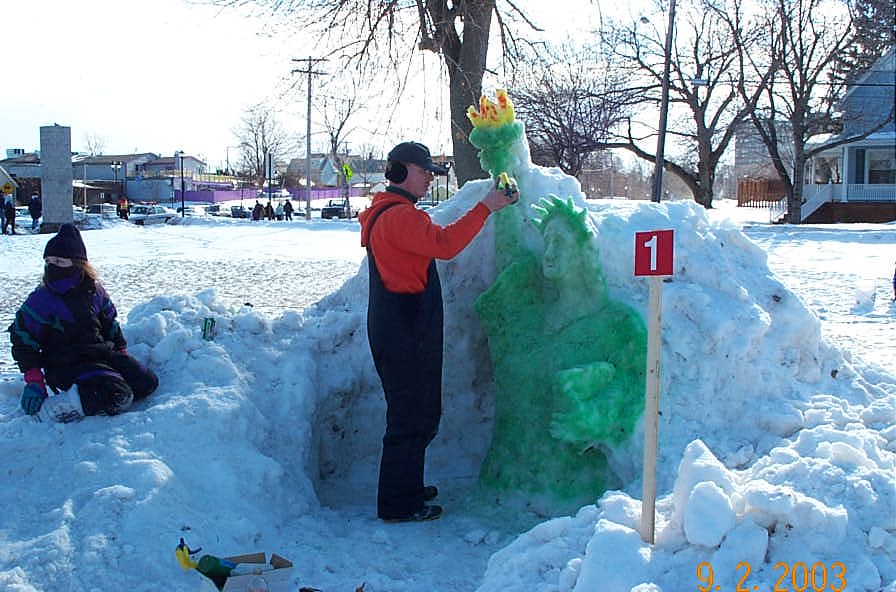
For example, make snow art! Not only is snow a great sculpting material, it takes to color quite nicely. Use spray bottles filled with cold water and food coloring to give your sculptures some dimension. Or, enjoy using your physics knowledge. Kristen Will and Samantha Stewart in Canada played around to see what would happen to boiling water when it comes into contact with -22 F air. Experiment and let us know what you discover.We'd love to hear what you're up to!

Tuesday, January 4, 2011

New and Improved Quizzes

2010 was an introspective year here at Visionlearning. We spent a lot of time thinking about how to make what we offer more accessible to you -- the result, in part, being this blog and our Facebook page. We've launched updates to our Glossary App so you don't have to set the language default to English, and added terms and names to our Glossary. We even published our Process of Science modules in book form!

And we spent a lot of time rewriting our quizzes.

With the exception of the Chemistry modules, all of our modules now have improved quizzes! In many cases it was a matter of adding more question items. (All of our quizzes have between 7 and 10 questions, now, and are more comprehensive.) In other cases it was about getting rid of old items and replacing them with fresh ones.

In our efforts to be of better service to students and teachers, we used Bloom's Taxonomy as a basis for this revision. Not only do our questions test your knowledge in different ways, they give a far better idea of knowledge gaps. What could be better than that? We translated them into Spanish! Since many of our users read the Spanish versions of our modules for support, we thought it only made sense to translate the quizzes as well.

There are more change to come in 2011, so stay tuned. And, we are always looking for feedback, so let us know what you think when you take one of the revised quizzes. If you have other suggestions for our website, send us an email! We want to hear from you.

Wednesday, December 1, 2010

New Clues into Asthma Occurrences

Throughout the US, asthma rates have been steadily increasing over the last few decades. According to the CDC, the rates of self-reported asthma conditions rose 75% between 1980 and 1994 (doctor's visits more than doubled between 1975 and 1990). Today, an estimated 15 million Americans deal with this condition.

While scientists still have nothing conclusive to explain why asthma is becoming more prevalent, new research is being conducted exploring potential connections between asthma and bacteria. In the last ten years, studies in both the US and Copenhagen have shown that infants born to asthmatic mothers have a different variety of bacteria in their lungs and guts than those born to non-asthmatics. Likewise, different bacteria exists for those born naturally versus those delivered through C-section. And, again, for those living in highly sterile environments.

If this research is considered in connection with asthma experiments conducted on rats, the bacteria-asthma connection becomes stronger. Rats exposed to yeast and mold spores had a greater incidence of developing asthma when they were also given an antibiotic drug.

There is still much work to be done, but it does raise the question of whether the significant increase of antibiotic hand-washes, toys, and cleaners that has occurred in the last two decades has had an unintended effect on our health. Likewise, it raises questions about whether we'll find physical evidence to support the long-argued claim that eating certain foods affects asthma symptoms.

What are your thoughts?

Monday, November 29, 2010

Feeling Creative?

A misconception about science and scientists that still hangs around is that science is made up of mostly boring, systematic methodology conducted by old, stodgy men in white lab coats. Nothing could be further from the truth, of course.  That's why we've created a new module on Creativity in Science!

This module, written by Barry Bickmore, highlights how creativity and ingenuity play crucial roles in scientific practice. From genetics to DNA recombination, creativity has been an important factor in discovering what we know about the world and all that is in it. It helps us break down complex questions and concepts into digestible chunks, as well as look at a problem from many different angles.

We'd love to hear your thoughts on this module, and suggestions on how to incorporate creativity into everyday scientific practice. Share with us here, or on our Facebook page!

Monday, November 22, 2010

Talking Turkey -- Using Science to Cook the Perfect Bird

We all want it -- a fat, juicy, golden bird on Thanksgiving Day. One that melts in your mouth. One who's flavor explodes and sends you into turkey bliss. One that you can't stop eating because it tastes sooo good and ends up sending you into a slumber on the couch during the afternoon football game (not due to tryptophan, but from a carb-heavy meal).

But how many of us actually get it? How many of us have worked out that seemingly magical combination of basting and cooking times so that we reach this Holy Grail of Turkeydom? Surprisingly, not so many!

Let us help you get a little closer to that dream this year by breaking down some of the science behind roasting the perfect bird.

Physiology
The first thing to understand is the physiology of our illustrious Meleagris gallopavo. Turkeys are birds, which means that they fly. Right? But, they also spend a lot of time walking about on the ground. As a result, the muscle mass in a turkey's body is pretty much split up into two groups: the breast and the legs.

The breast muscles are located close to the bird's center of gravity, which helps it both flap its wings and control its position in flight. But turkeys don't migrate -- they hang around their home turf all year round. In reality, the heavier percentage of a turkey's lifetime activities are spent on their two little legs, not flying about. Flight is typically reserved for roosting in trees and quick escape from predators. This means that the more heavily used leg muscles are both greater in concentration of fat (because fat is an energy store) and full of blood-enriched tissue (because oxygen is required for energy conversion).

It's this discrepancy in muscle use that accounts for the difference in meat color and texture. The lesser used breast muscles are white and leaner, while the more active leg muscles are a nice dark color with more fat. Wild turkeys and those that are free range will tend to have a higher percentage of dark meat than those birds raised in mass production farms -- mainly because they get more exercise. (This in true for chickens, too, incidentally.)

Cooking
So what does it matter that the turkey uses its legs more than its wings? It means everything. Muscles are a combination of water, fat, and protein.The fibers within the muscle are primarily protein, and these need to be broken down in order for our bodies to process their goodness. Adding heat to our bird is what breaks down these muscle fibers.

The meat fibers as a whole tend to break down around 180 degrees Fahrenheit, unraveling and making our bird more tender. But if we apply heat for too long, those proteins begin to coagulate and make the bird dry and tough. The trick, here, is that the breast meat and the leg meat have different proportions of water, fat, and protein AND the amount of mass of the sections are different. (The legs are sticking off the body and smaller in size than the breast, right? They aren't going to cook at the same rate.)

What happens if we put our bird in the oven and cook it until the breast meat is a gorgeous 180 degrees Fahrenheit near the bone? The legs are overdone and falling off the bird. And if we cook it until the legs are a perfect 180 degrees? The breast meat is undercooked and tough.

So, how do we get moist, tender breast meat AND moist, tender dark meat?

Tricks for evening cooking time
We want our bird to come out of the oven with everything in a perfect state. In order to accomplish this, we need to accommodate for the cooking differentials explained above. Some will tell you that this means slowing down the cooking of the breast, and speeding up the cooking of the legs because dark meat takes longer -- but that ignores the fact that the legs are smaller in overall size than the breast. Though pound for pound leg meat will take longer to cook than breast, overall there is less leg meat on your Thanksgiving bird.

So what do we do?

Chef Iain Falconer of Olive's in NYC does NOT recommend putting ice packs on your turkey's breast for the hours leading up to the roasting, as you might read elsewhere. By cooling the meat down considerably, and letting the legs stay at room temperature, the time it takes for the breast meat to warm to cooking temperature will give the legs too much of a head start. Cooling the legs is a better idea, though not very practical. Instead, cover the turkey's legs with aluminum foil. The foil reflects the oven's heat significantly enough to create a temperature difference between the two parts of the bird. Take the foil off somewhere at the start of the last hour to get a beautiful color on the skin.


How long in the oven?
Once you've established that temperature difference in the muscle tissue, it's time to put your bird in the oven. Add some water or broth to the pan to stimulate steaming (and thus juiciness), then pop it in at 475 degrees Fahrenheit for 15 minutes. Starting high will cause the heat to hit your bird's skin first, which will force the fat to melt and the protein to unravel, then coagulate to form a nice crispy outer cover.

After 15 minutes, reduce the cooking temperature to 375 degrees and cook according to the weight of your bird. A turkey's perfect cooking time is 15 to 20 minutes per pound of weight, plus an extra 15 to 20 minutes at the end. If your bird is small, aim toward 20 minutes per pound; larger birds, aim toward 15 minutes. (This may seem illogical at first, but a smaller bird will be in the oven less time overall than the larger, so you'll need the little bit of extra time to make sure it's all cooked and the proteins are unraveled.)

When the breast meat has reached 180 degrees, all bacteria will have been killed. Your juices should run clear, and you can leave the bird to rest outside of the oven for 20 minutes to cool and reabsorb that moisture back into the meat. Cutting while fresh out of the oven will send the good juice into the gravy and not into the muscle fibers, leaving Tom the Turkey dry.

To stuff or not to stuff, that is the question
When a turkey is prepared for roasting, what is in its center? Nothing -- it's empty. Empty except for the various bacteria, like Salmonella, that tend to thrive on raw poultry products. If you then put stuffing into that cavity, you not only increase the overall mass of the bird, you create a wonderful haven for those bacteria to have their own little Thanksgiving party.

In order to raise the inner cavity (the stuffing) to the bacteria-killing temperature of 180 degrees Fahrenheit, you're going to need to roast that bird for a lot longer than the times described above. Which will result in what? You got it -- tough, dry, chewy turkey. Exactly what we're trying to avoid.

So, if you want that wonderful flavor of the bird infused into your 'stuffing', don't put it into the bird. Instead, use some of the juices from the cooking process to add flavor. If you're a bread stuffing fan, skip the water and use the juices to moisten that bread.


Have some tricks of your own you would like to share for a perfect Thanksgiving Feast? Share them with us on our Facebook page, or in the comments section below!

Tuesday, November 9, 2010

Surprise Discovery in the Milky Way

It seems that whenever we think we know something well, we're proven wrong. As was announced through a press release from NASA today, NASA's Fermi Gamma-ray Space Telescope has unveiled a previously unseen structure centered in the Milky Way. The feature spans 50,000 light-years and may be the remnant of an eruption from a super-sized black hole at the center of our galaxy.

"What we see are two gamma-ray-emitting bubbles that extend 25,000 light-years north and south of the galactic center," said Doug Finkbeiner, an astronomer at the Harvard-Smithsonian Center for Astrophysics in Cambridge, Mass., who first recognized the feature. "We don't fully understand their nature or origin."

The structure spans more than half of the visible sky, from the constellation Virgo to the constellation Grus, and it may be millions of years old. A paper about the findings has been accepted for publication in The Astrophysical Journal.

Finkbeiner and Harvard graduate students Meng Su and Tracy Slatyer discovered the bubbles by processing publicly available data from Fermi's Large Area Telescope (LAT). The LAT is the most sensitive and highest-resolution gamma-ray detector ever launched. Gamma rays are the highest-energy form of light.

Other astronomers studying gamma rays hadn't detected the bubbles partly because of a fog of gamma rays that appears throughout the sky. The fog happens when particles moving near the speed of light interact with light and interstellar gas in the Milky Way. The LAT team constantly refines models to uncover new gamma-ray sources obscured by this so-called diffuse emission. By using various estimates of the fog, Finkbeiner and his colleagues were able to isolate it from the LAT data and unveil the giant bubbles.

Scientists now are conducting more analyses to better understand how the never-before-seen structure was formed. The bubble emissions are much more energetic than the gamma-ray fog seen elsewhere in the Milky Way. The bubbles also appear to have well-defined edges. The structure's shape and emissions suggest it was formed as a result of a large and relatively rapid energy release -- the source of which remains a mystery.

One possibility includes a particle jet from the supermassive black hole at the galactic center. In many other galaxies, astronomers see fast particle jets powered by matter falling toward a central black hole. While there is no evidence the Milky Way's black hole has such a jet today, it may have in the past. The bubbles also may have formed as a result of gas outflows from a burst of star formation, perhaps the one that produced many massive star clusters in the Milky Way's center several million years ago.

"In other galaxies, we see that starbursts can drive enormous gas outflows," said David Spergel, a scientist at Princeton University in New Jersey. "Whatever the energy source behind these huge bubbles may be, it is connected to many deep questions in astrophysics."

Hints of the bubbles appear in earlier spacecraft data. X-ray observations from the German-led Roentgen Satellite suggested subtle evidence for bubble edges close to the galactic center, or in the same orientation as the Milky Way. NASA's Wilkinson Microwave Anisotropy Probe detected an excess of radio signals at the position of the gamma-ray bubbles.

The Fermi LAT team also revealed Tuesday the instrument's best picture of the gamma-ray sky, the result of two years of data collection.

"Fermi scans the entire sky every three hours, and as the mission continues and our exposure deepens, we see the extreme universe in progressively greater detail," said Julie McEnery, Fermi project scientist at NASA's Goddard Space Flight Center in Greenbelt, Md.
NASA's Fermi is an astrophysics and particle physics partnership, developed in collaboration with the U.S. Department of Energy, with important contributions from academic institutions and partners in France, Germany, Italy, Japan, Sweden and the United States.

"Since its launch in June 2008, Fermi repeatedly has proven itself to be a frontier facility, giving us new insights ranging from the nature of space-time to the first observations of a gamma-ray nova," said Jon Morse, Astrophysics Division director at NASA Headquarters in Washington. "These latest discoveries continue to demonstrate Fermi's outstanding performance."