Thursday, March 10, 2011

Need a Virtual Nerd?

There are times when even the most math-savvy of us can't figure out how to solve a problem. Other times, we struggle to grasp math concepts that are important to our research and studies. Now the folks at Quantile have brought us Math@Home to get us through.

Math@Home is the most recent addition to the Virtual Nerd system and was created to provide assistance to students struggling in math. While it's catered toward students in K through 12, it can be helpful to students of all ages and grades. Parents can create an account for children, specifying the state they live in to make sure the tutoring coincides with state curriculum, or students can create accounts for themselves. It allows you to enter textbook titles, then provides resources to augment the in-class learning (including instructional videos). The system also allows for quantile measurement, so you can track learning progress.

Have you used Virtual Nerd or Math@Home? Let us know your thoughts.

Friday, March 4, 2011

Who are you calling a hagfish?

Myxine glutinosa: the name (almost) says it all. The Atlantic Hagfish is well known for its ability to excrete a sticky, glutinous substance from its skin -- hence its more widely known moniker, "slime eel." The hagfish can excrete enough of this strong, fibrous slime at one time to fill a milk jug, giving it excellent protection against predators. (Imagine trying to wipe a gallon of super glue off your gills.)

But it seems the skin of the hagfish isn't just about excreting. Researchers at McMaster University in Hamilton, Canada have recently learned that absorption is going on, too. More specifically, as the hagfish burrows into a carcass to feed, it takes in nutrients through its mouth AND through its skin and gills. Who would have thought?

While this has been seen in invertebrate fishes, it's the first documentation of such an system in an animal so close to modern fishes and invertebrates (hagfish have a notochord, not an actual backbone). This reseasrch isn't just about nutrients, however. As a sea creature, hagfish also have to deal with saline levels (which can affect cell osmosis) and temperature changes. How their skin can handle these, as well as nutrient transfer, could lead to some interesting and important applications.

This "nasty creature of the sea" might not be so nasty after all! Read more about this new discovery here.

Wednesday, February 16, 2011

Mobile Technology in the Classroom

Mineral identification app for the iPad
It's pretty hard not to notice how ubiquitous mobile media consumption has become in the last 2 to 3 years. Comscore's 2010 US Digital Year in Review reports that "nearly 47 percent of mobile subscribers [are] connected media users" -- accessing information through browsers, apps, etc. Some institutions, like Long Island University, have started iPad Projects to assess the effect of new media technology on learning. At Visionlearning, our yearly assessment showed a remarkable increase in users accessing our site through mobile devices like iPads and smart phones.

So with this in mind, it begs the question: is mobile access the way of the future? If so, how does this change the way we (educators) disseminate information both within and outwith the classroom? And where is the content for use on these devices coming from?

There is currently a noticeable dearth of materials out there for educators and students to access. Most educational publishers seem to be going the route of exporting their textbooks into ePub and PDF format for use through apps like Stanza and iBooks. At the end of the day, though, how different is reading a book on a screen from reading it in paper format? It may be easier to carry, but in terms of its effect on learning...reading is reading.

There are many wonderful apps out there, as well -- everything from conversion tools to homework helpers. Though, again, these are created more toward revision and providing support (just like a calculator) than expanding the learning process. We can't help but feel that there is something more that these devices can be doing. Is the way forward about creating more interactive experiences? And if so, how will these experiences differ from those a student might get in the classroom or lab?  What are the benefits?

You can see there are a lot of questions, but not so many answers. Part of that may simply be that it is up to each of us to define how we use these devices and why. A significant part, though, may be that we aren't necessarily sure, yet, how the devices can enhance learning in a truly effective way -- at least not in a way that isn't already being tried with Multiple Intelligence/Learning Style theory.

What do you think? Is iPad, etc., usage in the classroom just another fad? How would you like to use these devices in teaching and/or learning?

Friday, February 4, 2011

Make Lemons Out of Lemonade

It's been a wacky winter for many of us, to say the least. It seems like every time we finish cleaning up from a storm, another one comes barreling in. While we're all probably pretty much done with snowfall for one winter (unless you ski), here are some fun ways to entertain yourself with what's already on the ground.

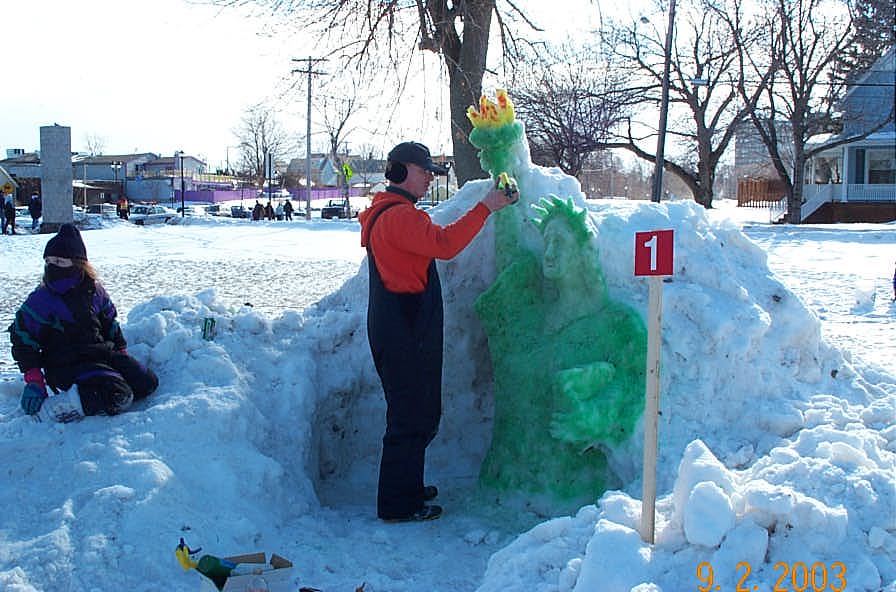
For example, make snow art! Not only is snow a great sculpting material, it takes to color quite nicely. Use spray bottles filled with cold water and food coloring to give your sculptures some dimension. Or, enjoy using your physics knowledge. Kristen Will and Samantha Stewart in Canada played around to see what would happen to boiling water when it comes into contact with -22 F air. Experiment and let us know what you discover.We'd love to hear what you're up to!

Tuesday, January 4, 2011

New and Improved Quizzes

2010 was an introspective year here at Visionlearning. We spent a lot of time thinking about how to make what we offer more accessible to you -- the result, in part, being this blog and our Facebook page. We've launched updates to our Glossary App so you don't have to set the language default to English, and added terms and names to our Glossary. We even published our Process of Science modules in book form!

And we spent a lot of time rewriting our quizzes.

With the exception of the Chemistry modules, all of our modules now have improved quizzes! In many cases it was a matter of adding more question items. (All of our quizzes have between 7 and 10 questions, now, and are more comprehensive.) In other cases it was about getting rid of old items and replacing them with fresh ones.

In our efforts to be of better service to students and teachers, we used Bloom's Taxonomy as a basis for this revision. Not only do our questions test your knowledge in different ways, they give a far better idea of knowledge gaps. What could be better than that? We translated them into Spanish! Since many of our users read the Spanish versions of our modules for support, we thought it only made sense to translate the quizzes as well.

There are more change to come in 2011, so stay tuned. And, we are always looking for feedback, so let us know what you think when you take one of the revised quizzes. If you have other suggestions for our website, send us an email! We want to hear from you.

Wednesday, December 1, 2010

New Clues into Asthma Occurrences

Throughout the US, asthma rates have been steadily increasing over the last few decades. According to the CDC, the rates of self-reported asthma conditions rose 75% between 1980 and 1994 (doctor's visits more than doubled between 1975 and 1990). Today, an estimated 15 million Americans deal with this condition.

While scientists still have nothing conclusive to explain why asthma is becoming more prevalent, new research is being conducted exploring potential connections between asthma and bacteria. In the last ten years, studies in both the US and Copenhagen have shown that infants born to asthmatic mothers have a different variety of bacteria in their lungs and guts than those born to non-asthmatics. Likewise, different bacteria exists for those born naturally versus those delivered through C-section. And, again, for those living in highly sterile environments.

If this research is considered in connection with asthma experiments conducted on rats, the bacteria-asthma connection becomes stronger. Rats exposed to yeast and mold spores had a greater incidence of developing asthma when they were also given an antibiotic drug.

There is still much work to be done, but it does raise the question of whether the significant increase of antibiotic hand-washes, toys, and cleaners that has occurred in the last two decades has had an unintended effect on our health. Likewise, it raises questions about whether we'll find physical evidence to support the long-argued claim that eating certain foods affects asthma symptoms.

What are your thoughts?

Monday, November 29, 2010

Feeling Creative?

A misconception about science and scientists that still hangs around is that science is made up of mostly boring, systematic methodology conducted by old, stodgy men in white lab coats. Nothing could be further from the truth, of course.  That's why we've created a new module on Creativity in Science!

This module, written by Barry Bickmore, highlights how creativity and ingenuity play crucial roles in scientific practice. From genetics to DNA recombination, creativity has been an important factor in discovering what we know about the world and all that is in it. It helps us break down complex questions and concepts into digestible chunks, as well as look at a problem from many different angles.

We'd love to hear your thoughts on this module, and suggestions on how to incorporate creativity into everyday scientific practice. Share with us here, or on our Facebook page!